Ernst Barlach
Biography of German Wood Carver, Expressionist
Sculptor.
MAIN A-Z INDEX - A-Z of SCULPTURE

|
Ernst Barlach
|
|
BEST 3-D ARTISTS |
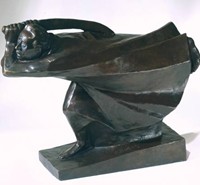
Ernst Barlach (1870-1938)Northern German sculptor, printmaker and graphic artist, Ernst Barlach is best known for his wood carving, based on German Late Gothic work, and a number of bronze figures. Among his wood sculptures, his single figures of beggars and peasants were greatly inspired by his visual experiences in Russia (1906), and reflect his dramatic and emotive style. Along with the expressionist sculptor Wilhelm Lehmbruck (1881-1919), Barlach is regarded as one of the most important early 20th century sculptors, and an artist who helped initiate the German Expressionism movement. Noted examples of his sculpture include the bronze figurine The Avenger (1914, Tate Museum, London) and his life-size Hovering Angel (1927), Gustrow Cathedral. Much of his powerful, often pessimistic, plastic art was destroyed by the Nazis. Surviving works are mostly to be found in German museums, including the small Barlach museum, near Luneburg. |
|
BEST SCULPTURES EVOLUTION OF SCULPTURE MODERNIST SCULPTURE |
|
Alexander
Calder (1898-1976)
MEDIA |
Artistic Training Born in Holstein in 1870, Barlach showed an early interest and talent for the art of sculpture. In 1891 he enrolled at the Royal Art School of Dresden, where he studied under the prominent Dresden sculptor Robert Diez for the next four years. During this period Barlach created his first important sculptural work, The Herb Plucker (1894). In 1895 he moved to Paris to continue his studies at the Julian Academy, coming into contact with the primtivism of Gauguin and the Nabis group of artists. His French teachers encouraged him to replicate the success of French modernism, but while Barlach liked the Impressionists, he was determined to follow his own path. He returned to Germany where he worked as a sculptor in Altona and Hamburg, creating sculptures in the Art Nouveau style. He also produced illustrations for Jugend, the famous Art Nouveau magazine. Constantly on the move, Barlach began teaching pottery at a school and starting creating realistic sculptures. He held his first exhibition in 1904 in Berlin. Unfortunately, recognition was slow in coming. |
|
|
Russia In 1906 Barlach travelled to Russia, where he was greatly influenced by the people and landscape. After this period, his art - whether sculpture, drawings or prints - became more dramatic, and less decorative. His figures often appear isolated, in their own world. He created a body of ceramic figures of beggars and peasants, downtrodden in their daily struggle for existence. He managed to incorporate folk art and design into his future work. Examples of works from this period include Blind Beggar and Russian Beggar-Woman with a Bowl. The sculptures are almost crudely carved, the expressions of the figures powerful, their bodies draped in heavy clothing. They are almost medieval in style. In fact much of Barlach's mature work is wood-carving, a medium that has been largely ignored since the Late Gothic period around the time of master-carvers like Veit Stoss (1450-1533), Tilman Riemenschneider (c.1460-1531) and Gregor Erhart (c.1470-1540). Another example of Barlach's work from this period is Sitting Woman (1908).
War World I When Barlach returned from Russia, his financial situation improved considerably when he received a fixed salary from the art dealer Paul Cassirer in return for his sculptures. As World War I approached, Barlach, like most citizens, was a firm supporter of the war. His patriotism can be seen in his small bronze sculpture The Avenger (1914, Tate Gallery, London) which represents the German Army as an unstoppable force. In 1915 he volunteered to join the army as a soldier, but within 12 months his experiences had turned him into a pacifist and staunch opponent of the war. In 1926, Paul Cassirer organised an exhibition in Berlin of 37 wooden sculptures by Barlach. The exhibition was widely acclaimed, and led in 1933 to the award of the Prussian Order of Merit. Barlach was finally a success. He produced several war memorials, the most famous being the bronze sculpture of a Hovering Angel, suspended outside of Gustrow Cathedral in 1927. This was a life-size figure of Barlach's artist-friend Kathe Kollwitz (1867-1945). Degenerate Art In 1933 the Nazi party issued a manifesto on artistic and cultural policy. It stated that "sculptures that are offensive to the national sensibility and yet still desecrate public squares and parks should disappear as quickly as possible, regardless of whether these works were created by ‘geniuses’ like Lehmbruck or Barlach." Some of Barlach's works, along with those by artists like Paul Klee (1879–1940), Kurt Schwitters (1887-1948), Oskar Kokoschka (1885-1980), Max Beckmann (1884-1950), Ernst Ludwig Kirchner (1880-1938), Marc Chagall (1887-1985) and Otto Dix (1891-1969) were included in the notorious Degenerate Art Exhibition (1937), which was organised by the Nazi party to discredit modern art. Most forms of modern art were denounced as degenerate, including Cubism, Dada, Surrealism, Symbolism, post-Impressionism and Fauvism. Those artists who were unlucky enough to be denounced were also dismissed from teaching posts and forbidden to exhibit or sell their works. Many of Barlach's war memorials were removed from public view. Additionally he was banned from working as a sculptor, while his membership to the Berlin Academy of Fine Arts was cancelled. He died soon after, in 1938. Other Creative Works In addition to sculpture, Barlach wrote one novel, eight plays and an autobiography (A Self Explained Life). He even won a German literary prize in 1924 for his efforts. He also created countless prints and woodcut illustrations for books and journals, among them 20 woodcuts based on a scene from Goethe's Faust (1923) and 17 large charcoal drawings of the Nibelungen Epic (an old German folk saga). Most of his drawings and illustrations are held in German and American private collections. Legacy Despite Barlach’s influence on the emergence of German Expressionism, he remains relatively unknown, for reasons which are not entirely clear. After his death, a Memorial exhibition was held in his honour at the Buchholz gallery in New York. The same year the London exhibition of '20th Century German Art', a protest against the German Degenerate Art Exhibition, displayed nine of his works. Today, Barlach's former home and studio in Gustrow, near Luneburg, are open to the public as a museum. |
|
• For more about the history and styles of plastic art, see: Homepage.
ENCYCLOPEDIA OF SCULPTURE |