Early Christian Art
Church Architecture, Mosaics, Sculpture,
Ivory Carving.
MAIN A-Z INDEX

|
Early Christian Art
|
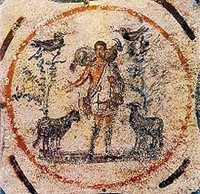 Early Christian Mural of the "Good Shepherd" (c.275) from the Catacomb of Priscilla, Rome. One of the earliest religious paintings yet discovered. |
Early Christian Art (c.150-1100)Contents • Introduction |
|
|
This topic concerns Christian art of the early era of Christianity, up to the establishment of the Eastern Roman Empire in Constantinople, and the collapse of the Western Roman Empire in Rome itself. We then examine how this nascent religious art developed in one particular country (Ireland), during the period c.550-1100. We have chosen Ireland, because it was the only country in Western Europe who kept the flame of Christianity burning during the Dark Ages, while managing at the same time to preserve other forms of ancient art and culture, including elements of Mesopotamian art and Greek civilization. If the history of art in the West is indebted to Christian artworks, the latter in turn is indebted to the efforts of St Patrick, and the traditions and craftsmanship of Celtic art. The revival of Continental Christian culture - originating in the form of 9th century Carolingian art and its successor Ottonian art - was due in no small measure to the influence of Irish artist-monks, and other learned advisers from the Irish Monastic system. Characteristics of Early Christian Art Nearly all our knowledge of early Christian culture and artifacts comes largely from archeological discoveries. Sadly, very few sacred artworks or designs survived from the first three centuries of Christian faith, mostly because of persecution and because a high proportion of early Christians were poor people or slaves. Even so, the first examples of this form of art appeared around 150 CE, well before Constantine's Edict of Milan, legalizing Christianity in 313. Almost all these early Christian artifacts were found in the West, and were based initially on the pagan forms and conventions of Roman art - and Greek art - then in use: only the themes were different, and only slowly did they become explicitly Christian. Among the earliest examples were practical items such as rings and seals, engraved with symbolic motifs like a dove, an anchor, or a lighthouse. To these innocuous-looking emblems were added images of the "Good Shepherd", loaves and fishes, and other designs, all of which appeared in paintings from about 200 onwards, many of which were unearthed in Rome from catacomb burial chambers outside the city walls. Virtually all surviving Christian painting comes from the catacombs. Typically simpler in technique and design than contemporary pagan art, it is frequently ambiguous in its imagery: an image of a shepherd carrying a sheep - carved on a sarcophagus, or painted on a catacomb wall - could be either pagan or Christian, though in hindsight the true meaning is usually unmistakable. The Chi-Rho symbol (used to make a Sacred Monogram symbolizing Christ) often appears, and would be understood only by a Christian. But some images remain obscure, such as the mural painting of a woman and child in the Catacomb of Priscilla (c.250). It might be a prototype Virgin and Child, or the Egyptian goddess Isis and her son Horus, whose cult was popular in Rome at the time. One might think that - because of the links between early Christianity and Judaism, and Jewish hostility towards images and idolatry, due to the Second Commandment - that all pictures of Christ and the Holy Family would have been banned. However, this Commandment was not strictly enforced within Hellenized Jews of the Diaspora. For example, the 3rd-century synagogue at Dura-Europos (now Qalat es Salihiye), between Aleppo and Baghdad on the Euphrates, was decorated with fresco painting that featured an extensive array of biblical illustration, as does the Jewish cemetery on the Appian Way just outside Rome. If Jews were permitted such latitude, it is hardly surprising that Christians in Rome (most of whom had never been Jews) were happy to use such imagery. Even up to 313, during the period when Christianity was banned, there was no interference with Christian cemeteries, which were legally protected under Roman law that regarded the burial of bodies as sacrosanct. Burial places were either in private hands, or belonged to firms established for the purpose, allowing Christians to be buried together. Most early Christian imagery used on sarcophagi and tombs consisted of illustrative Biblical art, such as scenes from the Old Testament of the Bible, such as: Moses striking the Rock, Daniel in the Lions' Den, Jonah and the Whale, Noah receiving the Dove with the Olive Branch, all signifying the Resurrection or Salvation. References to the Eucharist were also widespread, including: a standing cup and loaves, loaves and fishes, or even a picture of the rite itself, such as the one in the 3rd-century Cappella Greca in the Catacomb of Priscilla. Only in the 4th century did explicit images of Christ become common, probably because of a lingering concern about making an image of the Deity. An early example of a portrait of Christ was a bust flanked by the alpha and omega, found in the 4th-century Catacomb of Comidilla. A half-figure with the gesture of an Orant, thought to portray the Virgin Mary, was found in the Coemeterium Maius on the Via Nomentana. The Orant, an image of a woman standing with her arms upraised in prayer, representing faith, or the triumph of the Church, is a very common motif in Christian paintings from the 3rd century onwards. During the 4th century, scenes illustrating the mission and miracles of Christ became common. They included: the Samaritan Woman at the Well, the Raising of Lazarus, Christ blessing the Loaves at the feeding of the five thousand, the Wedding at Cana, and others.
|
|
Early ecclesiastical architecture reflected the needs of both clergy and congregation. The basic difference between a Christian church and a pagan temple, is that the latter was designed to be the dwelling of the God/Goddess in question, and the place where priests of the cult might offer suitable sacrifices and hold ceremonial rites. It was a sacred place, to which ordinary devotees of the cult were not allowed entry, no matter how large it was. (See also: Greek architecture.) In contrast, a Christian church was designed as a place of worship for the local congregation. To begin with, the small groups of persecuted Christians sought inconspicuous anonymity. They worshipped in secret house-churches or similar meeting-places, which were entirely devoid of any external architectural design or decorative art. (One of the earliest surviving examples is the 3rd century house-church excavated at Dura-Europos.) But as Christian communities expanded, following the Edict of Milan, they required larger churches, capable of hosting growing congregations and increasing numbers of clergy. This was achieved during the 4th century, when the basic church design were established, based on the Roman public building called a Basilica. Typically, it consisted of a large oblong-shaped chamber with doors at the west end, and an apse at the east end which housed the altar. (If a basilica is dedicated to a martyred saint, the latter's remains are usually enshrined beneath the altar in the confessio.) The central nave of the hall had aisles along the walls on either side, separated by a line of columns. The nave walls rose above the aisles, allowing the hall to receive light from windows in the clerestory. Sometimes the basilica would have a transept between the nave and the apse, but this only became a common feature during the 5th century when clergy required more space near the altar. Variations of the design included the Hellenic type, the Transverse Basilica and the later Hall-Church. Most early Christian church architecture is located in urban areas, as Christianity was essentially an urban religion, due to the fact that pagan beliefs were usually far more ingrained in rural areas. Where space permitted, separate Baptisteries were built, designed around a circular or octagonal central plan, to host various rites, notably baptism, since non-baptized converts were not permitted to enter the basilica itself. Up until the 6th century, however, baptisteries were generally limited to cathedrals only. As Christianity grew in popularity and official esteem, the liturgy of The Mass not only became more uniform but also increased in solemnity, to reflect the role of the emperor as the earthly representative of Christ the Heavenly King. As it did so, adjustments were made to the architectural design of the Christian basilica, to accomodate the growing ceremonial complexity. Constantine launched an official building program of Christian churches in Rome and the Holy Land, which focused on sacred sites. (See also: Roman Architecture.) Such sites included the place where a christian had been martyred, often already commemorated by the construction of a martyrium or cella memoriae. Thus Constantine built Saint Peter's Basilica (322-29) on the traditional site of the martyrdom of St Peter, in Rome. The basilica was huge - about 390-feet in length, and some 200-feet wide. It had a transept marked by a triumphal arch, and colonnades separating aisles and nave. At the front of the church, running the entire width of the building was a narthex, reached through a large atrium, surrounded by a roofed colonnade. The large size of St Peter's was dictated by its role as a pilgrimage church, designed to accomodate thousands of visiting pilgrims. Thus, for the same reason, the entire building was in fact arranged like a giant martyrium. The tomb of St Peter was situated in the apse beneath a baldacchino supported by four columns, to allow pilgrims to get close to the apostle's relics. As a result, the altar was placed either in the transept or at the start of the nave. St Peter's Basilica was - in both size and arrangement - quite unlike the Bishop of Rome's Lateran Basilica, which was founded for Roman worshippers alone. The Lateran was built by Miltiades (Pope 311-314) on a piece of land adjoing the Lateran Imperial Palace in Rome, following the gift to him of both the palace (as an official residence for him as Bishop of Rome), and the land, by Constantine. The cathedral, known as the St John Lateran Basilica (San Giovanni Laterano), has a huge nave flanked by double aisles, and an apse at the western end (only later was the apse was placed at the eastern end, following the Byzantine tradition). Two other early Christian basilicas were constructed in Rome: The Papal Basilica of St Paul Outside the Walls (Basilica Papale di San Paolo fuori le Mura), and The Basilica of Saint Mary Major (Santa Maria Maggiore). The Papal Basilica of St Paul was built by Constantine over the reputed burial place of Saint Paul, replacing the memorial erected after the Apostle's execution. Paul's beheaded body is interred in the Basilica's crypt, some 5-feet below the altar. His head is supposedly buried at the St John Lateran Basilica. The Basilica of St Paul was the first major church to have the apse in the east. The Basilica of Saint Mary Major (Sta Maria Maggiore), the largest Catholic Marian church in Rome, was constructed during the reign of Pope Sixtus III (432-440), when Rome was seen as the centre of the Christian world. Built to commemorate the decision of the Council of Ephesus (431), that Mary was the Mother of God, the basilica is decorated with a series of outstanding mosaics, depicting scenes of her life and that of Christ, as well as scenes from the Old Testament. Despite the close links between Ravenna and Constantinople, Early Christian art and architecture in Italy was quite different from that which emerged in Byzantium (the old name for Constantinople) during the period c.400-600. This artistic difference grew up even though Ravenna (and also Venice) were influenced by Byzantine art, notably in the field of mosaic art and, to a lesser extent, architecture. |
|
|
Early basilicas and other churches were mostly decorated with mosaic art, as exemplified by the series of mosaics in Sta Costanza, a domed circular structure supposedly used as the burial chapel for Constantine's daughter. A huge prophyry sarcophagus, now on display in the Vatican Museums, is supposed to have been her tomb. The mosaic imagery is ambiguous in its symbolism and meaning; some of the Greco-Roman ceiling pictures are only Christian because they later acquired Christian significance. The mosaics (c.375) lining the apses of the chapels by the ambulatory, depict the traditio clavium - Christ giving the keys to Saint Peter - and the traditio legis - Christ giving the Law to Saint Paul. The apse mosaic of Sta Pudenziana (c.375), is the most hieratically straightforward, and has the clearest Christian message. Christ, shown as both teacher and lawgiver, while enthroned in majesty, is seated before a hill, symbolizing Golgotha, with a jewelled cross rising from it. The cross is flanked by the four symbols of the Evangelists - the tetramorph - while on either side of Christ himself stand the Apostles: Saint Paul in the position of honour to His right, and Saint Peter on His left. To the rear are two females: a Roman woman behind Paul, representing the Ecclesia ex gentibus, because Paul's mission was to the Gentiles, and Rome was Gentile. The female figure behind Peter represents the Ecclesia ex circumcisione, that is the Jewish people taught by Christ Himself. Behind the figures stand the churches pertaining to the two Ecclesiae: the Rotunda of the Anastasis or Resurrection in Jerusalem for Saint Paul, and the Church of the Nativity in Bethlehem for Saint Peter. Sadly, the mosaic was hideously mutilated in 1588, as a result of misguided "improvements" during refurbishment, and subsequently "restored". Similar mosaic decorations have been found in later Roman works including: the apse of Saints Cosmas and Damian (c.530); the Chapel of St Venantius in the Lateran Baptistery (c.615); the group image of Christ with Saints in the apse of Sta Prassede (7th century); and the mosaic (c.980) formerly in the atrium of St Peter's Basilica, now located in the Vatican Grotto. The most extensive early Christian mosaics in Rome are on the triumphal arch and the walls of the nave in the Basilica of Sta Maria Maggiore (c.432-40). The arch decorations show the Flight into Egypt, while the nave is decorated with Old Testament stories mostly from the Books of Exodus and Joshua. Other important mosaics include those in the Chapel of St Venantius (c.640, Lateran Baptistery). These feature a pantocrator flanked by angels above the apse, while below is a Virgin orans with three saints and an ecclesiastic on either side of her. More figures can be seen beyond the arch of the apse. The resemblance between the Virgin here and the Virgin in the Ascension in the famous Rabbula Gospels of c.586 indicates that the mosaic, too, may represent an Ascension. In addition, the figures of the saints bear a noticeable resemblance to those in the San Vitale mosaics, in Ravenna. For more details, see: Ravenna Mosaics (c.400-600). The mosaic showing the Oratory of Pope John VII in St Peter's (c.705) was lost during the rebuilding of the Basilica during the 16th century. But some of its fragments - a Nativity and a Virgin and Child - have survived in the Vatican Grottoes, while a greater than life-size Virgin is now an altarpiece in San Marco, Florence. Like many paintings from the period, early Christian sculpture - for tombs and sarcophagi - features figures or designs which are often ambivalent in their meaning. In part, they may be because the sculptors were nearly all pagan, and many sarcophagi were part-sculpted in provincial workshops and dispatched to Rome to be finished according to the customer's requirements. Some look as thought they were clearly made for Christian clients, and their use of traditional pagan forms is no more surprising than the use of pre-Christian building designs, or pagan mosaic motifs. A sarcophagus was the most expensive form of burial, and thus its occupant would have had a higher position in society than someone buried in the cubicula of the catacombs. But a clear line of development can be traced in how the imagery of the stone sculpture changes, though one should note that only a few sarcophagi are dated. Ambiguity occurs where the casket is decorated with the graceful SSS of strigil ornament, sometimes with a figure of a Genius and an upside down torch at either end - a traditional mourning figure - and a central relief sculpture of a shepherd with a sheep on his shoulders, or an Orant, both quite unspecific in meaning. Examples of such carved sarcophagi can be seen in the Terme Museum, Rome. A traditional motif of Roman tomb sculpture consisted of a row of arches enclosing figures - typically a central figure (philosopher/lawgiver) flanked by others. Christian sculptors readily adapted this pagan motif: the central figure became Christ the lawgiver or judge, while the subsidiary ones were converted into Apostles. This could be effected with complete discretion - see, for instance, caskets in Ravenna, San Francesco, and Arles Museum. Sometimes the carvers employed symbols, instead of a central figure, such as a Chi-Rho flanked by Apostles, a combination which appears on a sarcophagus in the Lateran Museum, Rome, although an additional relief depicting the guards watching over the Holy Sepulchre is explicit confirmation of the fact that the Chi-Rho is Christ. Many different Biblical stories, from both the Old and New Testaments were depicted by this form of relief sculture during the early Christian era. Pairs of incidents were often featured as types and antitypes: thus the Sacrifice of Abraham was often twinned with Christ before Pilate; Judas's Betrayal of Christ with the Arrest of Saint Paul. A particularly ornate sarcophagus is the massive two-tier casket made for Junius Bassus, Prefect of Rome (359, Museum of St Peter's, Rome). It features a total of ten Bible scenes, with (in the middle of the upper tier) a Traditio Legis of Christ with Peter and Paul, flanked by the Sacrifice of Abraham and the Arrest of Saint Paul on one side, and with Christ before Pilate on the other, and (on the lower tier) a centralized Entry into Jerusalem, flanked on the left by Adam and Eve, plus Job and his Comforters, while to the right are the depictions of Daniel in the Lions' Den and Saint Paul Being Led to Execution. When analyzed this strange mixture becomes an obscure sequence of the historical, the symbolic, and the typological, which is augmented by the tiny lambs, set out in the spandrels of the arches of the lower tier. The Christian iconography represented by this complex work clearly demonstrates that as early as the 4th century the basic narrative of the bible was being invested with multiple levels of meaning. Virtually no Christian statue or sculpture in the round has survived from the early period, almost certainly because of a strong reluctance to create anything that resembled a pagan idol. The few works that have survived include statuettes of the pagan image of Hermes Kriophorus (a discreet model for the Good Shepherd, and philosophers (discreet images of Christ in the Traditio Legis). Invariably, Christ is portrayed as the Good Shepherd, or as a lawgiver, never as Himself. Other notable early Christian sculpture includes numerous examples of ivory carving, typically used for the embellishment of useful objects, or as the covers for Gospel texts, and devotional diptychs. Notable examples include the carving of the Archangel Michael (c.330, British Museum, London); the Consular Diptych of the Consul Severus (470, Leipzig); the Diptych with Six Miracles of Christ (c.480, Victoria and Albert Museum, London); the Maries approaching the Angel at the Sepulchre (c.385, Milan); the Maries at the Sepulchre and the Ascension (c.400, Pinakothek, Munich). In addition, two ivory coffins have survived: the Brescia box and a casket in the British Museum, London (c.430), decorated with four small panels depicting scenes from Christ's Passion. including Christ condemned by Pilate, and Judas hanging from a tree next to what appears to be the earliest explicit picture of the Crucifixion. Another panel portrays the Resurrection, and shows soldiers sleeping next to a tomb with an open door, approached by the Holy Women, as well as Jesus appearing to the Disciples and doubting Thomas touching the wound in Christ's side. Other early Christian artworks include several examples of goldsmithing and ecclesiastical metalwork, as exemplified by some remarkable silver objects, including: the Antioch Chalice (now identified as a lamp not a chalice) (c.530, Metropolitan Museum of Art, New York); and a gilt reliquary decorated with four reliefs, reputedly sent by Pope Damasus to Saint Ambrose (c.382, Milan Catholic Treasury); and the ceremonial silver dish known as Missorium of Theodosius I (c.387, Real Academia de la Historia, Madrid). Illuminated Gospel Manuscripts The history of Illuminated Manuscripts shows very few illuminations from the Early Christian period. Important exceptions include: the famous Ethiopian Garima Gospels (c.487-88, Garima Monastery, Ethiopia), the world's oldest illuminated gospel text, whose 28 pages of illuminations are designed in the early Byzantine style; the Vienna Genesis (early 6th century, National Library of Austria, Vienna), the oldest well-preserved, illustrated biblical codex, produced in Syria during the first half of the 6th Century; the Rossano Gospels (Codex Purpureus Rossanensis) (6th century, Rossano Cathedral, Italy) one of the oldest surviving illuminated manuscripts of the New Testament, written after the reconquest of the Italian peninsula by the Byzantine Emperor Justinian I. The codex is celebrated for its preface containing miniatures of scenes from the Life of Christ; the Syrian Rabbula Gospels (c.586 CE, Laurentian Library, Florence) and the Saint Augustine Gospels (6th century, Corpus Christi College, Cambridge), produced in Italy, and sent by Pope Gregory to Saint Augustine in Canterbury England, in 601. |
|
|
Christian Art in Ireland (c.550-1100) Unlike Britain and Continental Europe, Ireland was never colonized by Rome. As a result, traditional Irish Celtic art was neither displaced by Greek or Roman art, nor buried in the ensuing "Dark Ages". Indeed, one of the defining features of Irish culture between the end of the Iron Age (200-100 BCE) and the gradual emergence of Christianity in Ireland from the third century CE onwards, was its unbroken tradition of Celtic culture influenced only marginally by Roman art. In the process, Irish culture retained its own oral historical and mythological traditions, as exemplified in the Lebor Gabála Erenn (Book of Invasions). Note that in 400 CE, the population of the country was between half a million and 1 million people. From the fifth-century CE onwards, Irish culture underwent a gradual but significant renaissance, resulting (after about 650 CE) in an outburst of Hiberno-Saxon style or Insular art. This cultural renaissance was due to three factors. The first, was the spread of Christianity throughout Ireland, a process attributed to St Patrick, which led to the foundation of numerous monasteries across the island - the basis for the resulting monastic Irish art. The second, was the appearance of the first written Irish, or Ogham script, which offered a new means of artistic activity and expression. The third factor, was the increased cultural contacts between Celtic Ireland and the Germanic Anglo-Saxons. But the impact of Christianity on Irish art should not be underestimated. The foundation of a tightly-knit network of monasteries throughout Ireland, Britain (especially Northumbria) and parts of Europe, all acting as centres of learning and artistic craftmanship as well as places of religious devotion, provided the perfect medium for a renaissance in religious art. Indeed, most insular art came about because of the patronage of the early Christian church. Irish Gospel Manuscripts The high point of this Insular art of the early Christian era was the creation of a series of illuminated manuscripts, notably of gospel texts. Monks carefully copied Christian Bible texts such as the Gospels, embellishing them with fantasy-filled ornamentation: see, for instance, the extraordinary Monogram Page in the Book of Kells. Most of the abstract forms (including spiral marking, knots, and tracery) which appear in these decorations, derived from traditional Celtic designs, replicated on many different objects including brooches and buckles. Other examples of artistic embellishment include: historiated letters, figurative miniatures, rhombuses, crosses, trumpet ornaments, as well as stylized images of animal and human heads, plants and birds, all drawn in vivid colours. Further decoration was added through the use of ornamental metalwork in silver, gold and precious gems. The earliest illuminations are the Cathach of Colmcille (c.610-20), the Book of Dimma (c.625), and the Durham Gospels (c.650), while the earliest complete insular illumination is the Book of Durrow (c.670). But the most famous of all illuminated texts is the Book of Kells (c.800; also called the Book of Columba), which is considered the apogee of Western calligraphy. It includes the four Gospels of the Bible, in Latin, together with introductions and explanations all embellished with numerous colourful illustrations and illuminations.
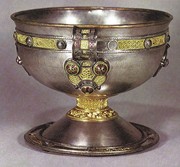
Metalworking The influence of the Celts is also evident in a range of crafts, including jewellery art, and goldsmithery. Examples of this Celtic metalwork art include masterpieces such as the Derrynaflan Chalice, the famous Ardagh Chalice, the Moylough Belt Shrine, as well as famous processional crosses such as the Tully Lough Cross and the Cross of Cong. High Cross Sculpture From about 790 to 1100, a new genre of freestanding stone sculpture - known as "High Cross Sculptures" - began to appear in Ireland. Decorated in carved relief, either with abstract patterns or various scenes from the bible, this art reached its zenith during the early tenth century, as evidenced by Muiredach's Cross at Monasterboice, County Louth, and the Ahenny High Cross in Tipperary. The influence of Viking art on early Christian culture in Ireland can be seen towards 1100, when Irish artists began to follow the Nordic Ringerike and Urnes styles, as in the Cross of Cong, in County Mayo and the crosses at Cashel. |
|
• For more about the arts of early Christianity, see: Homepage.
ENCYCLOPEDIA OF IRISH AND CELTIC ART |